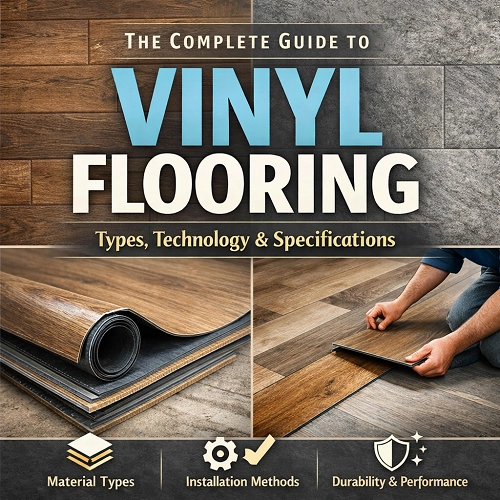
Vinyl flooring has evolved from a basic sheet product into one of the most technically advanced floor-covering categories available. Today it encompasses rigid-core composites, luxury planks, acoustic systems, and even antimicrobial medical panels — all built on a polymer platform that delivers waterproofing, durability, and design versatility at a competitive price point. This guide breaks down each major product type, the underlying construction technology, and the key performance metrics buyers should compare before specifying a product.
Reference data and product ranges in this article are drawn from Zhejiang Halead Flooring Co., Ltd — a wholesale manufacturer headquartered in Haining, Zhejiang Province, China — whose PVC flooring line and non-PVC alternatives cover virtually every modern vinyl category.
1. What Is Vinyl Flooring?
Vinyl flooring is a synthetic floor covering whose primary polymer binder is polyvinyl chloride (PVC) or, in newer non-PVC formulations, polypropylene (PP). The material is manufactured in layers — a structural core, a printed decorative film, and a protective wear layer — that are bonded under heat and pressure into a single rigid or semi-flexible plank or tile.
Layer Construction Overview
Modern vinyl planks and tiles typically consist of four to five functional layers:
| # | Layer | Material | Function | Typical Thickness |
|---|---|---|---|---|
| 1 | UV Coating | Polyurethane / ceramic bead | Scratch & stain resistance, gloss control | 0.05 – 0.10 mm |
| 2 | Wear Layer | Clear PVC | Abrasion resistance (AC rating) | 0.10 – 0.70 mm |
| 3 | Decorative Film | High-definition digital print | Visual design (wood, stone, abstract) | 0.07 – 0.12 mm |
| 4 | Core | SPC / WPC / LVT / PP | Structural rigidity or flexibility | 2.0 – 5.5 mm |
| 5 | Underlayer (optional) | IXPE / EVA foam | Sound absorption, thermal comfort | 0.5 – 2.0 mm |
2. Major Product Categories
The vinyl flooring market is segmented primarily by core construction. Each core type results in different performance characteristics, installation methods, and end-use suitability.
Stone Plastic Composite — ultra-rigid, dimensionally stable core
Luxury Vinyl Tile — flexible, glue-down or click format
Heavy-backed planks — no adhesive, no click lock
Stone Vinyl Plank — rigid variant with premium embossing
Integrated high-density foam for sound reduction
Non-PVC polypropylene — recyclable, phthalate-free
3. SPC Flooring — The Rigid-Core Revolution
Stone Plastic Composite (SPC) flooring is widely regarded as an upgraded generation of click LVT. Its core is composed of limestone powder, PVC resin, and stabilisers, calendared under high pressure into a board with virtually zero expansion or contraction across temperature swings. This dimensional stability makes SPC a natural fit for underfloor heating systems and climates with large seasonal humidity shifts.
SPC Core Composition
| Component | Approximate % by Weight | Role |
|---|---|---|
| Limestone (CaCO₃) | 50 – 60 % | Rigidity, weight, dimensional stability |
| PVC Resin | 25 – 35 % | Binding, waterproofing, flexibility balance |
| Plasticisers & Stabilisers | 5 – 10 % | Processing aid, UV / heat stability |
| Colour & Additives | < 5 % | Pigment, impact modifiers |
SPC Technical Specifications (Halead Range)
| Parameter | Value / Range | Standard |
|---|---|---|
| Total thickness | 3.2 – 6.0 mm (excl. underlayer) | — |
| Wear layer | 0.3 – 0.7 mm | EN 649 |
| Surface finish | Matte / Normal gloss | — |
| Embossing | Natural wood / Stone / EIR (Emboss in Register) | — |
| Installation | Unilin / Valinge click system | — |
| Dimensional stability | < 0.25 % change at 80 °C | ISO 23999 |
| Residual indentation | < 0.1 mm | ISO 24343 |
| Slip resistance | R9 – R11 | DIN 51130 |
4. LVT vs SPC vs WPC — Core Comparison
Buyers frequently face the choice between Luxury Vinyl Tile (LVT), Stone Plastic Composite (SPC), and Wood Plastic Composite (WPC). The table below maps each format across the decision factors that matter most in commercial and residential specification.
| Property | LVT (Flexible) | SPC (Rigid) | WPC (Rigid) |
|---|---|---|---|
| Core material | Flexible PVC composite | Limestone + PVC | Wood flour + PVC |
| Typical thickness | 2.0 – 3.5 mm | 3.2 – 6.0 mm | 5.0 – 8.0 mm |
| Dimensional stability | Moderate | Excellent | Good |
| Underfoot comfort | Good | Moderate | Excellent |
| Waterproof | Yes | Yes | Yes |
| Subfloor tolerance | Low (needs flat sub) | Moderate (3 mm / 1.8 m) | High (built-in cushion) |
| UFH compatible | Limited | Yes | Moderate |
| Typical use case | Light commercial, glue-down | High-traffic residential & commercial | Residential comfort focus |
| Price bracket | $ | $$ | $$–$$$ |
5. Wear Layer & AC Rating Explained
The wear layer is the single most important performance variable in any vinyl floor specification. Measured in millimetres, it is the transparent PVC film bonded above the decorative layer that resists scratches, scuffs, and abrasion from foot traffic. European markets use the AC (Abrasion Class) rating system, while North American projects often reference the mil thickness directly (1 mil = 0.0254 mm).
| Wear Layer | Mil | AC Rating | Suitable Application |
|---|---|---|---|
| 0.1 mm | 4 mil | AC1 | Light residential (bedrooms) |
| 0.2 mm | 8 mil | AC2 | General residential |
| 0.3 mm | 12 mil | AC3 | Heavy residential / light commercial |
| 0.5 mm | 20 mil | AC4 | Medium commercial (offices, retail) |
| 0.7 mm | 28 mil | AC5 | Heavy commercial (airports, hospitals) |
6. Acoustic Flooring & Sound Reduction
In multi-storey residential and commercial buildings, impact sound — footsteps, dropped objects — transmitted through floor slabs is a primary comfort concern. Acoustic vinyl flooring integrates a high-density foam or cork underlayer directly below the core to dampen this impact energy before it enters the building structure.
Impact sound reduction is rated by the Delta IIC (ΔIic) value in North America and the ΔLw value in Europe. A higher number means better attenuation. Pre-attached IXPE foam underlayers of 1.0 – 1.5 mm typically deliver ΔLw values of 17 – 22 dB, while products with 2.0 mm+ premium foam can reach 25 dB or above.
7. Non-PVC Alternatives — PP Flooring
Environmental regulations in the EU and growing demand from LEED-certified projects have accelerated the development of PVC-free vinyl flooring alternatives. Polypropylene (PP) flooring replaces the PVC binder with a thermoplastic olefin, eliminating chlorine chemistry and the phthalate plasticisers associated with traditional flexible vinyl.
| Property | Standard PVC Floor | PP Floor |
|---|---|---|
| Base polymer | Polyvinyl chloride | Polypropylene |
| Plasticisers | Phthalate / DINP | None required |
| Recyclability | Limited (mixed polymer) | Monomaterial — fully recyclable |
| REACH compliance | Requires phthalate-free declaration | Inherently compliant |
| Indoor air quality | FloorScore / GREENGUARD certified variants | Lower VOC baseline |
| Performance trade-off | Higher wear layer options available | Currently thinner wear layers typical |
8. Design Formats — Herringbone, Chevron & Beyond
Beyond the plank and tile formats, the growing design-floor segment delivers parquet-inspired patterns in the convenience of a click-lock vinyl system. Design vinyl floors are particularly popular in hospitality, boutique retail, and premium residential renovation where visual impact is as important as performance.
| Pattern | Plank Shape | Visual Effect | Link |
|---|---|---|---|
| Herringbone | Short rectangle, 45° offset joints | Classic chevron-like zigzag | View range |
| Chevron | Parallelogram plank, mitre-cut end | Continuous V-shape arrow pattern | View range |
| Design LVT | Oversize tile / plank formats | Large-format stone or exotic wood looks | View range |
9. Installation Methods
Installation method affects cost, reversibility, and suitability for specific subfloors. The three dominant methods for modern vinyl planks are summarised below.
| Method | How It Works | Best For | Removable? |
|---|---|---|---|
| Click-Lock (Floating) | Planks mechanically interlock along long and short edges; no adhesive | DIY, residential, renovation over existing floors | Yes |
| Glue-Down | Full-spread or pressure-sensitive adhesive bonds plank to subfloor | Commercial, high-traffic, wheeled traffic areas | Difficult |
| Loose Lay | Heavy fibreglass-reinforced backing holds planks in place by friction and weight | Quick-turn commercial, temporary installs, uneven slabs | Very easy |
For loose lay vinyl planks, the reinforced backing — typically a fibreglass mesh embedded in dense PVC or rubber — prevents the micro-movement that would cause standard flexible LVT to curl or shift. This makes loose lay a practical choice for commercial tenancies requiring rapid installation and future reconfiguration.
10. About Zhejiang Halead Flooring Co., Ltd
Zhejiang Halead Flooring Co., Ltd is a wholesale manufacturer based at No. 96 Haishi Road, Jianshan New Zone, Haining City, Zhejiang Province, China. The company produces a comprehensive range of flooring surfaces spanning PVC flooring, non-PVC flooring, wall panels, and design floors — all manufactured in-house with dedicated quality control processes.
Halead's product portfolio also includes specialist items such as the Antimicrobial Medical Panel — a homogeneous vinyl surface engineered for healthcare environments — and the HALEAD HIT Tiles, a modular tile system for high-impact zones. The company publishes detailed technical documentation, decor libraries, and product catalogues through its resources section.
| Detail | Information |
|---|---|
| Company name | Zhejiang Halead Flooring Co., Ltd |
| Headquarters | Haining, Zhejiang Province, China |
| Phone | 0086-573-87760778 |
| flooring@halead.com | |
| Product website | floor.halead.com/product/ |
| ESG commitment | Environmental, Social & Governance programme |
11. Buyer's Specification Checklist
Before placing an order for any vinyl flooring product, use the following checklist to ensure the specification matches the end-use environment.
| # | Question | Why It Matters |
|---|---|---|
| 1 | What is the expected foot-traffic class? | Determines minimum wear layer / AC rating |
| 2 | Is underfloor heating (UFH) present? | Requires SPC or products rated for >27 °C surface temp |
| 3 | What is the subfloor condition? | Uneven slabs may require loose lay or WPC for tolerance |
| 4 | Are there acoustic requirements or building codes? | Specifies minimum ΔLw or IIC value; pre-attached foam may be needed |
| 5 | Is the space wet or high-humidity? | Confirms waterproof core; check seam construction for glue-down |
| 6 | What certifications are required (GREENGUARD, CE, FloorScore)? | Impacts product selection and supplier documentation |
| 7 | Does the project have sustainability or LEED targets? | May require non-PVC, low-VOC, or recycled-content materials |
| 8 | What format (plank, tile, herringbone) and size? | Affects visual outcome, installation time, and material waste |
Explore Halead's Full Product Range
From SPC click planks to acoustic systems and antimicrobial wall panels — browse the complete catalogue or get in touch with the Halead team for wholesale pricing and technical support.
Browse All Products Contact Halead