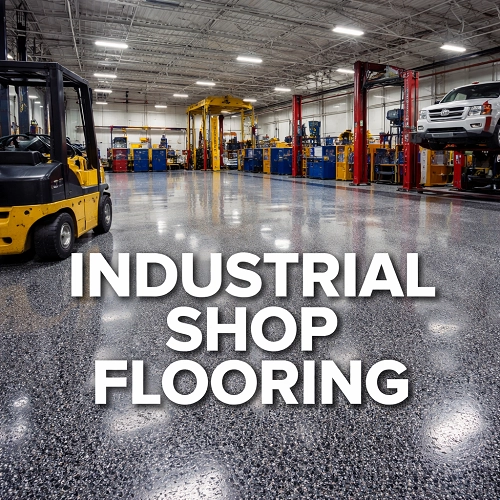
Industrial shop flooring is a critical component of manufacturing facilities, warehouses, automotive shops, heavy-equipment bays, and similar environments. Unlike residential or commercial flooring, industrial floors must withstand extreme conditions — heavy loads, impact, chemical exposure, abrasion, thermal cycling, and continuous traffic. Choosing the right system and maintaining it properly can dramatically affect safety, productivity, lifecycle costs, and long-term facility performance.
Key Performance Requirements for Industrial Flooring
Industrial shop floors serve as the foundation of operations.
The technical attributes required include:
Load-Bearing Capacity
Industrial floors must support static and dynamic loads:
- Static loads: Heavy machinery, storage racks, presses.
- Dynamic loads: Forklifts, transport vehicles, pallet jacks.
- Impact loads: Dropping heavy tools or metal parts.
The structural sub-slab and the surface finish must be engineered to prevent cracking, settlement, or surface deformation under the anticipated load spectrum.
Abrasion Resistance
Heavy traffic and material movement cause wear. Hard aggregate, high compressive strength, and dense surface materials help resist abrasion.
Chemical and Stain Resistance
Shops frequently encounter oils, fuels, solvents, acids, bases, and detergents.
Flooring must tolerate these exposures without degradation:
- Epoxy and polyurethane coatings offer excellent chemical resistance.
- Concrete densifiers limit penetration of contaminants.
Impact and Shock Resistance
Impact resistance is essential where tools or materials are dropped. Resinous flooring systems formulated with impact modifiers or flexible layers can absorb shock.
Thermal Tolerance
In facilities with steam, heat processes, welding, or temperature cycling, flooring must withstand:
- Thermal shock and expansion/contraction.
- Hot tire pickup (resin flooring softening under heat).
Polyurethane and hybrid systems often outperform epoxies in thermal resilience.
Slip Resistance
Surface texture must balance cleanability with slip control. Coefficient of friction (COF) targets depend on wet/dry service conditions.
Industrial Flooring Materials and Systems
Industrial floor systems typically consist of a structural slab and a surface layer engineered for performance.
Portland Cement Concrete (PCC)
Concrete remains the foundational material in most industrial shops due to its inherent compressive strength and cost-effectiveness.
Technical Details
- Mix design: Balanced for strength (typically 4,000–6,000 psi), durability, workability.
- Reinforcement: Steel rebar or wire mesh to manage tensile stresses.
- Control joints: Minimize random cracking due to shrinkage and thermal stresses.
- Dense aggregates: Improve abrasion resistance.
Concrete can be hardened, densified, and polished for enhanced performance.
Resinous Flooring Systems
Resinous surfaces are bonded to concrete to enhance performance.
Epoxy Flooring
- Composition: Epoxy resin + hardener.
- Properties: High compressive & tensile strength, chemical resistance, thicknesses from 10–125 mils.
- Limitations: Moderate flexibility; sensitive to moisture and hot tire pickup.
Polyurethane (PU) & Polyaspartic Coatings
- Advantages: Better UV/thermal resistance and flexibility than standard epoxies; faster curing.
- Applications: Areas with thermal cycling, exterior slabs, or rapid turnaround requirements.
Methyl Methacrylate (MMA)
- Rapid curing even at low temperatures.
- High chemical resistance.
- Strong odor and flammability during installation.
Self-Leveling Toppings
Used to correct surface irregularities and create a smooth, uniform profile before final coatings.
Acid-Stained / Integral Color Flooring
For aesthetics and moderate service conditions, coloring agents (pigments or stains) can be integrated.
Concrete Hardeners and Densifiers
Silicate or silicate-based materials react with free lime in concrete to form additional calcium silicate hydrate (C-S-H), increasing surface hardness and reducing dusting.
Design and Engineering Considerations
Substrate Evaluation
Before specifying a floor system, assess:
- Moisture vapor emission rate (MVER): High vapor drives adhesion failures in coatings.
- Flatness/levelness (F/N specifications): Critical for equipment installation and material handling operations.
- Crack patterns: Existing cracks may require routing and filling or isolation joints.
Load Analysis
Engineers evaluate:
- Wheel loads and load distribution from forklifts and conveyors.
- Point loads from machines and presses.
- Dynamic and cyclical stresses.
These inputs determine slab thickness, reinforcement, and surface system selection.
Jointing Systems
Control joints manage shrinkage cracks. Construction and isolation joints accommodate differential movement adjacent to walls or equipment.
Thermal and Moisture Concerns
Provision for:
- Moisture barriers: Vapor barriers beneath slabs prevent moisture drive and adhesion issues.
- Thermal breaks: Mitigate expansion strain near hot processes.
Installation Best Practices
Surface Preparation
Proper preparation is critical:
- Mechanical profiling: Shot blasting or diamond grinding to ensure a clean, textured substrate.
- Contaminant removal: Oils, grease, curing compounds, paint residues must be eliminated.
- Moisture testing: Calcium chloride tests, relative humidity probes validate readiness.
Environmental Controls
Temperature, humidity, and ventilation affect cure times and final properties.
- Resin systems often require specific temperature ranges and low humidity.
- Concrete needs curing time before coatings (often 28 days for traditional mixes unless fast-track admixtures used).
Sequencing and Quality Control
- Joint sealing, primer application, intermediate layers, and topcoats must follow manufacturer specifications.
- Field testing for thickness (dry film thickness gauges) and adhesion (pull-off tests) ensures performance.
Common Technical Issues and Solutions
Moisture Vapor Emission Problems
- Issue: Blistering, delamination, or coating failure.
- Causes: High slab moisture, inadequate vapor barrier.
- Solutions: Moisture mitigation systems, proper testing, vapor-tolerant coatings.
Cracking
- Issue: Structural or surface cracks propagate.
- Causes: Inadequate jointing, thermal expansion, subgrade movement.
- Solutions: Proper joint design, reinforcement, crack repair materials.
Hot Tire Pickup
- Issue: Flooring softens and adheres to tires under heat.
- Causes: Low heat resistance coatings (e.g., some epoxies).
- Solutions: High-temperature resistant polyurethanes or polyaspartics.
Abrasion and Surface Wear
- Issue: Grinding, pitting, loss of sheen.
- Causes: Heavy traffic, inadequate hardness.
- Solutions: Hardeners/densifiers, thicker epoxy systems, periodic resealing.
Chemical Attack
- Issue: Surface degradation, discoloration, etching.
- Causes: Exposure to strong acids, alkalis, solvents.
- Solutions: High-grade chemical resistant coatings and impermeable surface treatments.
Safety and Ergonomics
Industrial flooring is also about human and machine safety:
- Slip resistance: Defined COF targets (e.g., ≥0.6 dry, ≥0.8 wet for industrial floors).
- Color coding: Painted zones for walkways and hazard areas.
- Anti-fatigue mats: In standing workstations where hard floors can cause worker discomfort.
Maintenance and Lifecycle Management
Cleaning Protocols
Regular cleaning prevents abrasive particulate buildup and chemical staining:
- Daily sweeping and dust control.
- Periodic scrubbing with appropriate detergents.
- Avoid harsh acids unless surface rated.
Inspection and Repair
Routine inspection identifies worn areas, joint failures, delamination, or chemical damage.
Repair strategies include:
- Spot grinding and recoating.
- Joint resealing.
- Full area recoating on a scheduled lifecycle basis (often 5–10 years depending on use).
Cost Considerations and Value Analysis
Initial material and installation costs vary significantly:
- Concrete with densifier: Low to moderate.
- Epoxy coatings: Moderate.
- Polyurethane/polyaspartic systems: Higher upfront cost.
- MMA systems: Premium.
However, total lifecycle cost — incorporating downtime, maintenance frequency, and replacement — is the more meaningful metric. High-performing systems can reduce long-term expenditures and operational disruptions.
Emerging Trends and Technologies
- Self-healing coatings that repair minor surface cracks.
- Antimicrobial flooring for environments requiring biosecurity.
- Smart sensors embedded in slabs for structural health monitoring.
- Sustainable products with lower VOCs and recycled content.
Industrial shop flooring is a sophisticated engineered system that must address structural loads, chemical exposures, thermal conditions, safety requirements, and budget constraints. Proper selection, design, installation, and maintenance underpin facility performance, worker safety, and operational continuity. By understanding technical parameters and potential pitfalls, facility managers and engineers can make informed decisions that deliver durable, safe, and cost-effective floor solutions for demanding industrial environments.