Hard interlocking floor tiles — often called click-lock resilient tiles or rigid interlocking vinyl tiles — are engineered flooring panels that snap together edge-to-edge without glue, wet trades, or curing time. Built around a rigid core (typically SPC — stone plastic composite) and a mechanical tongue-and-groove or drop-lock profile, they are increasingly specified for warehouses, distribution centers, workshops, garages, and light-industrial floors where forklifts, pallet trucks, and rolling loads are part of daily operations.
1. What Are Hard Interlocking Floor Tiles?
A hard interlocking floor tile is a resilient flooring plank or tile whose core layer is rigid enough to span small subfloor imperfections without a full adhesive bed. Each piece is milled with an interlocking profile along its edges — most commonly a mechanical click/fold-down joint — so that adjoining tiles lock together into a continuous "floating" floor. Because the core resists compression and flex, the format is frequently chosen for industrial and commercial floors that see concentrated point loads from wheeled equipment, as opposed to residential click flooring designed mainly for foot traffic.
The category sits at the intersection of two flooring families: rigid-core resilient flooring (SPC/LVT) and traditional interlocking tile systems. The "hard" qualifier distinguishes these products from soft interlocking tiles made of rubber or foam EVA, which cushion and flex underfoot but are not rated for heavy rolling loads.
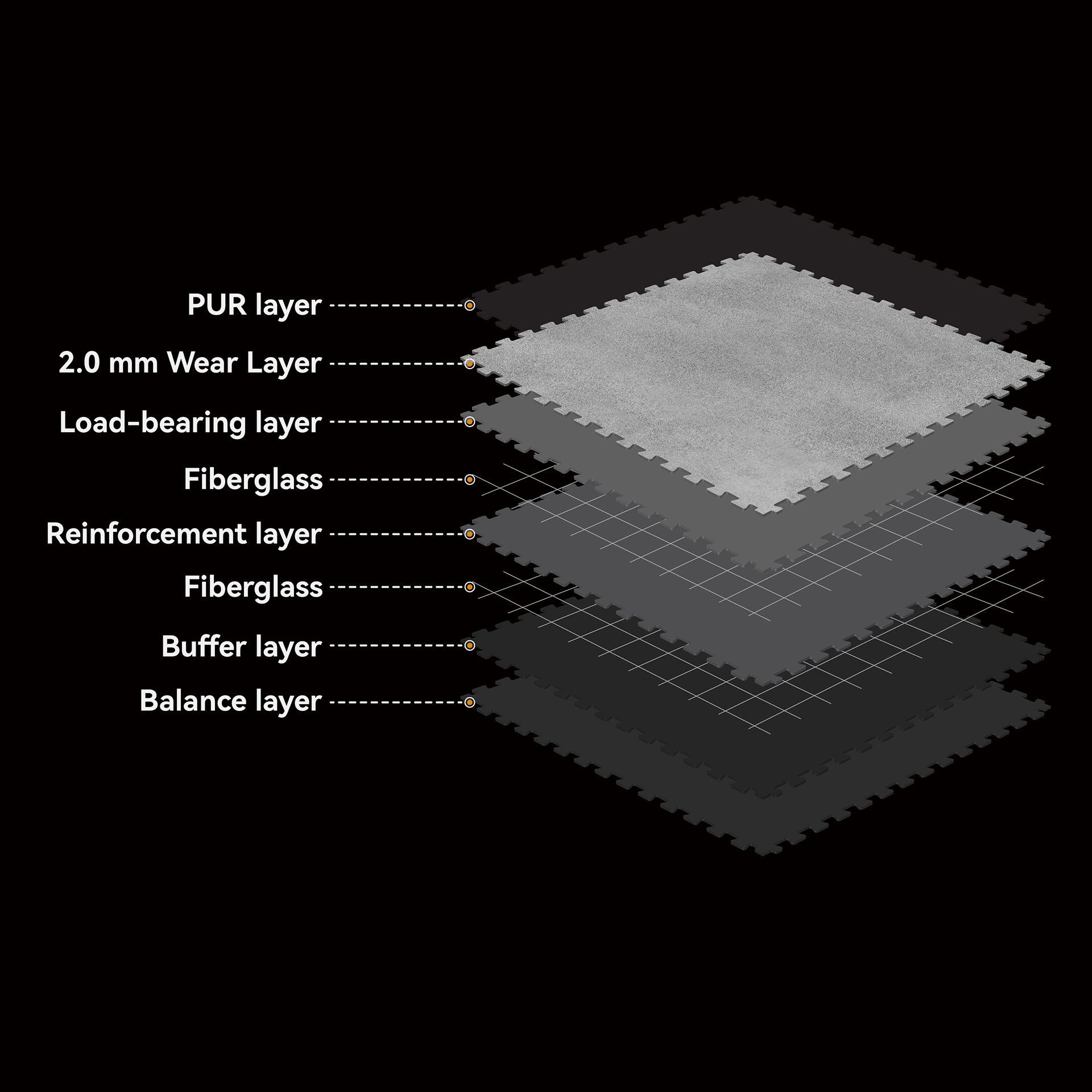
2. Layer-by-Layer Construction
Nearly every hard interlocking tile on the market — regardless of brand — is built as a laminate stack. Understanding each layer helps explain why the finished product performs the way it does under rolling and point loads.
| Layer | Function | Typical material |
|---|---|---|
| UV / PUR coating | Scratch, stain, and chemical resistance; simplifies cleaning | Polyurethane (PUR) lacquer |
| Wear layer | Abrasion and impact resistance; determines duty rating | Clear PVC, 0.3–0.7 mm |
| Décor / print film | Visual design layer (embossing, texture) | Printed PVC film |
| Rigid core | Dimensional stability, load bearing, holds the click profile | SPC (calcium carbonate + PVC composite) |
| Underlayer (optional) | Sound dampening, minor subfloor tolerance | Attached foam or cork pad |
The rigid core is what separates hard interlocking tiles from soft-format interlocking flooring. Because the core does not compress meaningfully under a rolling wheel, load is distributed rather than concentrated at a single contact point, which reduces the risk of the surface tearing or permanently denting the way a foam-backed product can.

3. Interlocking Systems Compared
Not all "interlocking" floors join the same way. The mechanism matters for installation speed, joint tightness under load, and how the floor behaves at expansion gaps.
| System | How it works | Best suited for |
|---|---|---|
| Angle-fold click | Tile inserted at an angle then folded flat to lock the tongue into the groove | General commercial/light-industrial floors; the system used on HALEAD HIT Tiles |
| Drop-lock (fold-down) | Tile is placed flat and tapped down; a locking tab engages vertically | Tight spaces where angling a full tile is impractical |
| Loose-lay friction fit | Heavy backing and butt-jointed edges rely on mass and friction, not a milled profile | Frequent-access floors (data centers, retail resets) |
| Glue-assisted click | Mechanical click supplemented with adhesive at seams for permanence | High-shear areas such as forklift turning zones |
4. Performance Data: Slip, Impact, Scratch, and Acoustics
Because hard interlocking tiles are frequently specified for safety-critical environments, their performance is usually described against four practical criteria: slip resistance, impact/point-load resistance, surface scratch resistance, and impact noise. As an example of published performance data, our own HIT Tiles range is rated R10 for slip resistance and its PUR-coated surface withstands 38 N of applied force in Martindale micro-scratch testing, with a thickened wear layer and multi-layer pressure-resistant core aimed at forklift and pallet-truck traffic.
| Criterion | What it measures | Why it matters for interlocking tiles |
|---|---|---|
| Slip resistance (R-rating) | Ramp-test friction rating from R9 (least resistant) to R13 (most resistant) | Determines suitability for damp, oily, or dusty industrial floors; R10 is a common minimum for warehouse walkways |
| Micro-scratch / hardness | Force (in Newtons) a surface can withstand before visible scratching under abrasive contact | Predicts how the floor will look after repeated pallet, cart, or foot traffic |
| Impact / point-load resistance | Resistance to denting or cracking from dropped tools or wheeled loads | Governs whether the floor is fit for forklifts, pallet jacks, or rolling racks |
| Impact sound / acoustics | Noise generated by foot or wheel traffic on the surface | Relevant for occupied spaces above or adjacent to the production floor |
| Head-impact severity | Energy absorption in the event of a fall | A resilient tile generally performs better than hard ceramic tile in fall-impact scenarios |
5. Relevant Test Standards
Specifiers comparing hard interlocking tiles between suppliers typically ask for results against recognized, named test methods rather than marketing claims alone. The table below lists standards that are commonly referenced across the resilient flooring industry for the properties discussed above; always confirm current certificates directly with the manufacturer's technical documentation before specifying.
| Standard | Property tested |
|---|---|
| ISO 10874 | Classification of resilient floor coverings by use-class (domestic, commercial, industrial) |
| EN 649 / ISO 24343-1 | Residual indentation of homogeneous and heterogeneous resilient floor coverings |
| DIN 51130 | Ramp-test slip resistance classification (R9–R13) |
| EN 13501-1 | Reaction-to-fire classification of building products |
| ASTM F970 | Static load limit / indentation resistance of resilient floor coverings |
| ISO 4211 | Determination of dimensional stability of resilient floor coverings |
6. Hard Interlocking Tiles vs. Epoxy, Ceramic, and Glue-Down Vinyl
Facility managers evaluating an industrial floor upgrade generally weigh four options. The table below summarizes the practical trade-offs; it is intended as a planning aid, not a substitute for a site-specific assessment.
| Attribute | Hard interlocking tile | Epoxy coating | Ceramic tile | Glue-down vinyl |
|---|---|---|---|---|
| Installation downtime | Low — no cure time, walkable immediately | High — multi-day cure and re-coat cycles | High — grout and adhesive cure time | Medium — adhesive cure before full traffic |
| Subfloor prep required | Minimal; tolerant of slightly uneven, damp, or dusty slabs | Extensive — grinding, priming, moisture testing | Extensive — leveling and waterproofing | Moderate — must be dry and fully leveled |
| Impact / crack risk | Low; resilient core absorbs point loads | Low to moderate; can chip at edges | Higher; grout and tile can crack under heavy impact | Low to moderate |
| Repair method | Unclick and replace a single damaged tile | Patch and re-coat affected area | Break out and re-grout individual tiles | Cut and re-glue the affected section |
| Underfoot noise/comfort | Quieter than hard tile; some cushioning with underlayer | Hard, high sound reflection | Hardest underfoot, high sound reflection | Comparable resilience to interlocking tile |
7. Specification Table & How to Select a Thickness
Thickness selection depends primarily on subfloor condition and traffic type. As a reference point, HALEAD HIT Tiles ship in three core thicknesses, each targeted at a different traffic profile:
| Parameter | Value |
|---|---|
| Overall thickness (excluding underlayer) | 5.0 mm / 6.0 mm / 8.0 mm |
| Surface finish | Normal (matte utility finish) |
| Installation method | Click (angle-fold interlocking) system |
| Embossing options | Gravel, Concrete, Tire, Foam, SK |
| Slip rating | R10 |
| Micro-scratch resistance | 38 N (Martindale test) |
As a general rule of thumb (not a substitute for a structural assessment):
- 5.0 mm — light-duty back-office, retail stockrooms, and pedestrian-only industrial zones.
- 6.0 mm — mixed pedestrian and light pallet-truck traffic, general warehouse aisles.
- 8.0 mm — sustained forklift traffic, workshop floors, and areas with frequent dropped-tool risk.
8. Installation Process
One of the defining advantages of hard interlocking tiles is installation speed — a floating click floor can typically be installed roughly five times faster than a conventional glued or grouted floor, with no requirement to halt operations for adhesive curing.
| Step | Task | Notes |
|---|---|---|
| 1 | Site survey and acclimation | Let tiles acclimate to room temperature for 24–48 hours before laying |
| 2 | Surface check | Sweep or vacuum; minor unevenness, dust, and light dampness are generally tolerable, but loose debris and standing water are not |
| 3 | Layout planning | Establish a working line from the longest, most visible wall; leave an expansion gap at fixed perimeters |
| 4 | Interlocking | Angle each tile into the previous row and fold flat to engage the click joint |
| 5 | Perimeter and transitions | Trim final row to size; fit transition strips at doorways and expansion joints |
| 6 | Inspection and sign-off | Check joint tightness and flatness before returning the area to service |
For high-shear zones such as forklift pivot points, a glue-assisted click installation (mechanical lock plus adhesive at the seam) is sometimes recommended to prevent joint creep over time. Ask your supplier's technical services team whether this is advisable for your specific traffic pattern.
9. Maintenance and Lifecycle Care
The PUR-coated wear layer used on most hard interlocking tiles is designed to reduce maintenance burden compared with porous or coated hard-surface floors:
- Daily: dry dust-mop or auto-scrub to remove grit that can act as an abrasive under wheels.
- Weekly: damp-mop with a neutral-pH cleaner; avoid solvent-based strippers on the PUR coating.
- Periodic: inspect click joints in high-shear zones (dock doors, turning aisles) for any separation and re-engage promptly.
- Spot repair: because tiles are mechanically joined rather than bonded, a single damaged tile can typically be unclicked and swapped without disturbing the surrounding floor.
10. Best-Fit Applications
| Environment | Why it fits |
|---|---|
| Warehouses & distribution centers | Fast installation over existing concrete without halting operations; withstands pallet-truck and forklift traffic |
| Manufacturing workshops | Impact and scratch resistance under tools, carts, and machinery |
| Garages & vehicle service bays | Tolerant of oil, dust, and minor subfloor unevenness |
| Retrofit / occupied-building upgrades | No wet trades or extended cure time means less disruption to ongoing operations |
| Gyms & fitness facilities | Resilient underfoot feel with lower impact-noise transfer than hard tile |
11. Frequently Asked Questions
Can hard interlocking tiles be installed over an uneven or damp concrete slab?
Rigid-core click tiles are generally more tolerant of minor surface imperfections, light dust, and residual dampness than glue-down or grouted systems, because there is no adhesive bond requiring a fully dry, primed substrate. Significant unevenness, active moisture ingress, or structural cracking should still be addressed before installation.
How long do hard interlocking floor tiles last in an industrial setting?
Service life depends heavily on wear-layer thickness, traffic intensity, and maintenance discipline, but the mechanically replaceable nature of interlocking tiles means individual worn tiles can be swapped without replacing the whole floor, which extends the practical lifespan of the installation as a whole.
Do interlocking tiles need an expansion gap?
Yes. As a floating floor, the tile field expands and contracts slightly with temperature; a perimeter gap at fixed walls, columns, and door frames — covered by trim or transition strips — allows for this movement.
Are hard interlocking tiles suitable for forklift traffic?
Purpose-built industrial ranges — such as HALEAD HIT Tiles — are specifically engineered with a thickened wear layer and multi-layer pressure-resistant structure for frequent forklift and pallet-truck traffic. Standard residential-grade click flooring is not rated for this duty and should not be substituted.