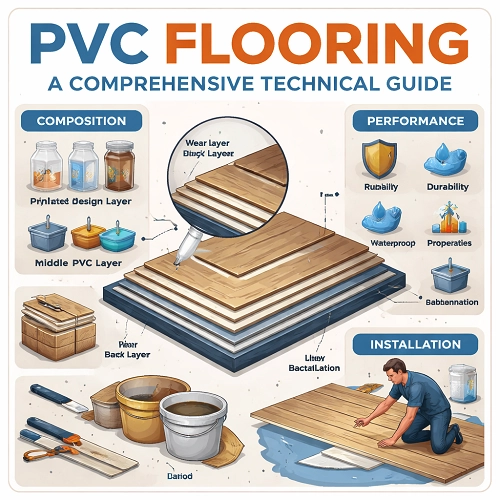
Polyvinyl chloride (PVC) flooring has become a dominant material in modern construction due to its versatility, durability, and cost-efficiency. Used across residential, commercial, and industrial environments, PVC flooring offers a wide range of performance characteristics that can be tailored to specific applications.
1. What is PVC Flooring?
PVC flooring is a synthetic flooring material made primarily from polyvinyl chloride, a thermoplastic polymer. It is commonly available in several formats, including:
- Luxury Vinyl Tiles (LVT)
- Vinyl sheets
- Vinyl planks (LVP)
- Homogeneous and heterogeneous vinyl flooring
Each format is engineered for different use cases, balancing aesthetics, durability, and ease of installation.
2. Chemical Composition and Material Structure
2.1 Base Polymer: Polyvinyl Chloride
PVC is produced through the polymerization of vinyl chloride monomer (VCM). Its properties can be modified by adding:
- Plasticizers (e.g., phthalates or non-phthalate alternatives) to increase flexibility
- Stabilizers (e.g., calcium-zinc compounds) to improve thermal stability
- Fillers (e.g., calcium carbonate) to reduce cost and adjust mechanical properties
- Pigments for coloration
2.2 Layered Construction
Most modern PVC flooring products use a multi-layered structure:
- Wear Layer
- Transparent top coating
- Typically made of urethane or enhanced polyurethane
- Determines abrasion resistance and lifespan
- Printed Design Layer
- High-resolution photographic layer
- Mimics wood, stone, or ceramic
- Core Layer
- Can be flexible (traditional vinyl) or rigid (SPC/WPC)
- Provides structural stability
- Backing Layer
- Enhances dimensional stability and moisture resistance
- May include foam for acoustic insulation
3. Types of PVC Flooring
3.1 Homogeneous Vinyl Flooring
- Single-layer construction
- Uniform composition throughout thickness
- High durability and ideal for heavy traffic (e.g., hospitals)
3.2 Heterogeneous Vinyl Flooring
- Multi-layer structure
- Offers better design flexibility
- Common in commercial and residential settings
3.3 SPC (Stone Plastic Composite)
- Rigid core made from limestone and PVC
- High dimensional stability
- Excellent for high-moisture environments
3.4 WPC (Wood Plastic Composite)
- Foamed core structure
- Softer underfoot
- Better acoustic and thermal insulation
4. Mechanical and Physical Properties
4.1 Durability and Wear Resistance
- Wear layer thickness (measured in mils or mm) directly impacts longevity
- Commercial-grade products typically use 20–40 mil wear layers
4.2 Water Resistance
- PVC is inherently waterproof
- Ideal for kitchens, bathrooms, and basements
4.3 Dimensional Stability
- Influenced by temperature and humidity
- Rigid core products (SPC) exhibit minimal expansion/contraction
4.4 Slip Resistance
- Measured using coefficients of friction (COF)
- Surface embossing and coatings improve safety
4.5 Acoustic Performance
- Impact sound reduction depends on backing layer
- Foam-backed variants can significantly reduce noise transmission
5. Manufacturing Process
PVC flooring is produced through several industrial processes:
5.1 Calendering
- Heated rollers form sheets of vinyl
- Used for flexible vinyl products
5.2 Extrusion
- Material is forced through a die
- Common for rigid core planks
5.3 Lamination
- Layers are bonded under heat and pressure
- Ensures structural integrity
5.4 Surface Treatment
- UV-cured coatings applied
- Enhances scratch and stain resistance
6. Installation Methods
6.1 Glue-Down Installation
- Adhesive applied to subfloor
- Suitable for high-traffic commercial areas
- Provides strong bond and stability
6.2 Click-Lock (Floating Floor)
- Interlocking edges
- No adhesive required
- Faster and easier installation
6.3 Loose Lay
- Relies on weight and friction
- Minimal adhesive or perimeter fixing
- Ideal for temporary or modular setups
6.4 Subfloor Requirements
- Must be clean, dry, and level
- Moisture barriers may be required
- Tolerance typically ±3 mm over 2 meters
7. Thermal and Fire Performance
7.1 Thermal Conductivity
- Moderate thermal insulation
- Compatible with underfloor heating systems (within temperature limits)
7.2 Fire Resistance
- PVC is inherently flame-retardant due to chlorine content
- Meets various fire safety standards (e.g., ASTM E648, EN 13501-1)
8. Environmental and Health Considerations
8.1 VOC Emissions
- Modern products are low-VOC
- Certifications include FloorScore and GREENGUARD
8.2 Recycling and Sustainability
- PVC is recyclable but infrastructure is limited
- Some manufacturers use recycled content
8.3 Plasticizer Concerns
- Shift from phthalates to safer alternatives
- Important for indoor air quality
9. Maintenance and Lifecycle
9.1 Cleaning
- Requires regular sweeping and damp mopping
- Avoid abrasive cleaners
9.2 Repairability
- Individual planks/tiles can be replaced
- Sheet vinyl is harder to repair
9.3 Lifespan
- Residential: 10–25 years
- Commercial: 5–15 years depending on traffic
10. Advantages and Limitations
Advantages
- Waterproof
- Cost-effective
- Wide design options
- Easy installation
Limitations
- Susceptible to indentation from heavy loads
- UV exposure may cause fading
- Not biodegradable
PVC flooring is a highly engineered material that combines polymer science, layered construction, and advanced manufacturing techniques to deliver a versatile flooring solution. Its adaptability across various environments—from residential interiors to high-traffic commercial spaces—makes it one of the most widely used flooring materials today. Understanding its technical properties, installation requirements, and environmental impact allows architects, engineers, and homeowners to make informed decisions when selecting flooring systems.